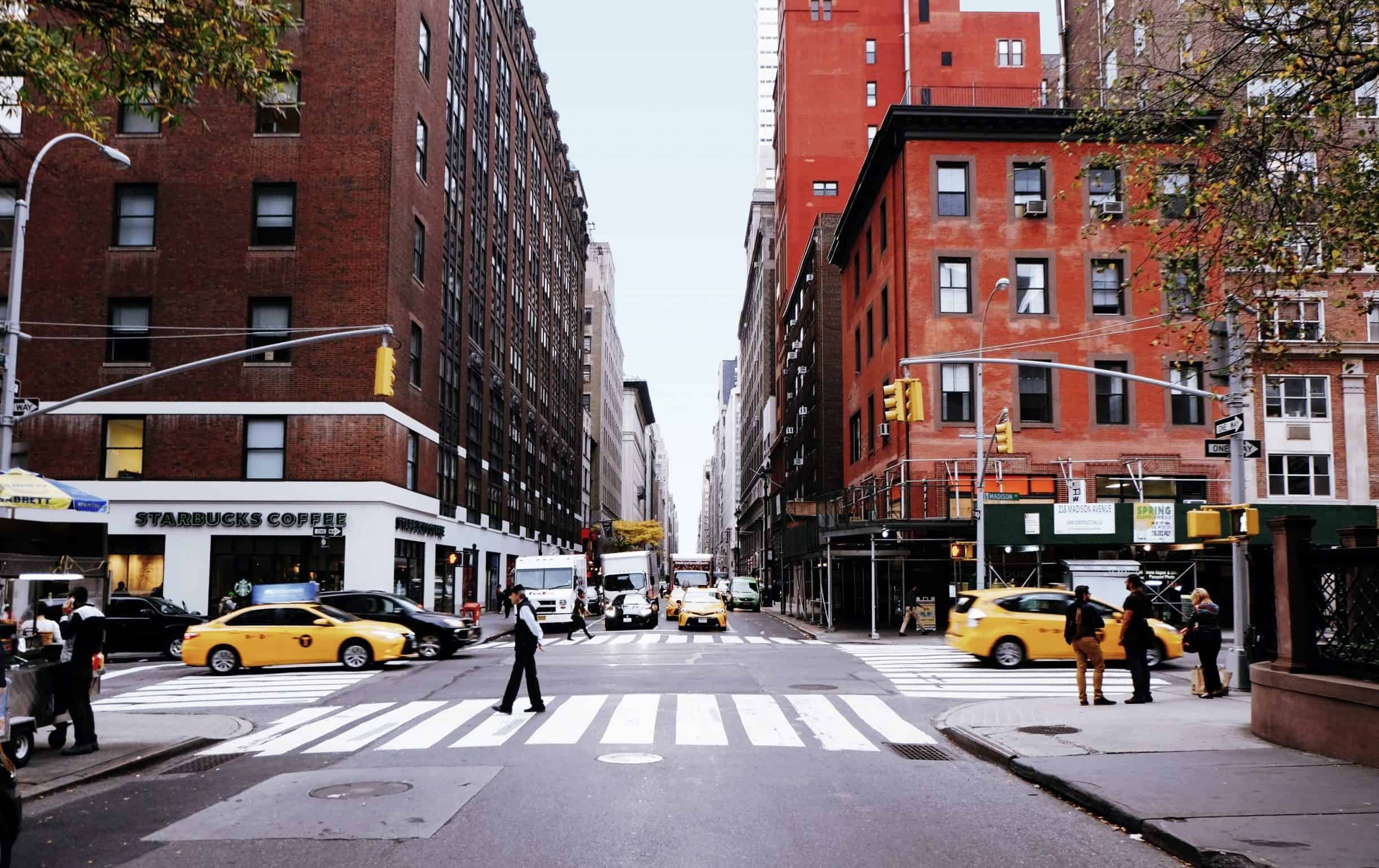
The best neighborhoods in Manhattan for most renters are the Upper West Side and the Upper East Side for quiet streets and park access, Morningside Heights, Harlem and Washington Heights for lower rents with fast express trains, and the West Village, East Village and Chelsea if you want to walk to everything downtown. Which one is best for you comes down to three things: your budget, your commute and how late you want your street to stay awake.
This guide compares 13 Manhattan neighborhoods side by side: who each one suits, what recent movers actually pay, and which subway lines you get. Rent numbers come from the NYU Furman Center neighborhood profiles, so you can compare areas on the same yardstick instead of on listing photos.
Manhattan neighborhoods compared at a glance
Rent below is the median monthly rent paid by households that recently moved into their home (2024, in 2025 dollars). The Furman Center reports it by district, so neighbors that share a district share a number.
For comparison, the Manhattan-wide median for recent movers is $3,290. Keep in mind that these figures are for whole apartments of any size, including rent-stabilized units, so a one-bedroom listing in a popular block can be well above them.
How to choose where to live in Manhattan
Manhattan is usually split into three parts: Uptown (above 59th Street), Midtown (roughly 34th to 59th) and Downtown (roughly below 14th Street), with Chelsea, Flatiron and Gramercy in between. Before you pick one of the best places to live in Manhattan, answer four questions.
- Where do you commute? Look for a stop on one line that goes straight to your office or campus. An express stop can make a farther neighborhood faster than a closer one.
- What is your real monthly budget? Add utilities, internet and furniture to the rent before comparing.
- How quiet do you need it? The East Village and Lower East Side stay loud late. The Upper West Side and Roosevelt Island go quiet early.
- How long will you stay? A 12-month lease fits people who know the city. If you are here for a semester or an internship, look at month-to-month options.
Best Manhattan neighborhoods Uptown
Upper West Side
The Upper West Side sits between Central Park and Riverside Park, from 59th Street to about 110th. Residents get Lincoln Center, the American Museum of Natural History and long residential blocks of brownstones and prewar buildings. The 1 train runs local along Broadway, the 2 and 3 run express, and the B and C follow Central Park West. It is one of the calmest parts of Manhattan. Read our full Upper West Side guide for blocks, food and parks.
Upper East Side
The Upper East Side runs from Central Park to the East River. Museum Mile along Fifth Avenue holds the Met and the Guggenheim, while the avenues east of Lexington have more walk-up apartments and a younger crowd. The Second Avenue subway (Q train) added stops at 72nd, 86th and 96th Streets, which took pressure off the 4, 5 and 6 on Lexington. It is also handy for the hospitals on York Avenue.
Morningside Heights
Morningside Heights is the campus neighborhood: Columbia University, Barnard College, Teachers College and the Manhattan School of Music all sit here, between Morningside Park and Riverside Park. The 1 train stops at 110th and 116th Streets, and the B and C run along the park to the east. Rents for recent movers in the district (shared with Hamilton Heights) were $2,510 in 2024, well under the Manhattan median. Our Morningside Heights guide covers the blocks around campus.
Harlem
Harlem gives you some of the fastest trains in Manhattan for less rent. At 125th Street, the A and D run express to Midtown, and the 2 and 3 run down Lenox Avenue to Times Square and the Financial District. Recent movers in Central Harlem paid a median of $2,380 in 2024. You also get the Apollo Theater, Marcus Garvey Park and a long stretch of brownstone blocks.
Washington Heights
Washington Heights, at the northern end of the island, had the lowest recent-mover rent in this guide: $2,190 in 2024 for the district it shares with Inwood. The A train runs express from 168th and 175th Streets to Midtown, and the 1 train covers the Broadway side. NewYork-Presbyterian and the Columbia University Irving Medical Center are at 168th Street, so many medical and nursing students live here. Fort Tryon Park and the Cloisters are a short walk north, and the Hudson Heights blocks west of Broadway are some of the quietest in Manhattan.
Best Manhattan neighborhoods Downtown and in Chelsea
Chelsea
Chelsea runs along the West Side from about 14th to 30th Street. The High Line passes through it, the gallery district fills the blocks near Tenth and Eleventh Avenues, and Chelsea Market sits on Ninth Avenue. You get the A, C and E on Eighth Avenue, the 1 on Seventh and the L across 14th Street. Recent movers paid a median of $4,100 in 2024, so most people under 30 here share an apartment.
West Village and Greenwich Village
Greenwich Village is built around Washington Square Park and NYU. The West Village, on the Hudson side, has the irregular streets that do not follow the grid, plus small restaurants and jazz clubs like the Blue Note and the Village Vanguard. West 4th Street station connects seven lines (A, C, E, B, D, F, M), and the 1 stops at Christopher Street. It is also the most expensive area on this list: recent movers paid a median of $4,430 in 2024. See our Greenwich Village guide for more.
East Village
The East Village, between 14th Street and Houston east of Broadway, has the densest mix of bars, late-night food counters, music venues and walk-up apartments downtown. The L runs across 14th Street to Williamsburg, the 6 stops at Astor Place and the F at Second Avenue. Its district (shared with the Lower East Side and Chinatown) had a median recent-mover rent of $3,140 in 2024. Tompkins Square Park is its backyard. Expect noise on weekend nights, especially on the avenues.
Lower East Side
The Lower East Side, south of Houston Street, mixes 19th-century tenements with new glass towers. Orchard and Ludlow Streets hold bars and small venues, and the Tenement Museum explains how the area was built. Delancey-Essex station gives you the F, J, M and Z, so Midtown and Brooklyn are both one train away. The rent figure is the same district number as the East Village: $3,140 for recent movers in 2024.
Financial District and Battery Park City
Many apartment buildings in the Financial District are converted office towers, often with a doorman and laundry in the building. Fulton Street station connects the 2, 3, 4, 5, A, C, J and Z, and the PATH at the World Trade Center goes to New Jersey. Battery Park City, on landfill along the Hudson, is quieter, with a waterfront esplanade and lawns. Streets empty out after office hours and on weekends, which some residents like and others do not. The recent-mover median was $4,430 in 2024 (a figure shared with Greenwich Village and SoHo). If you like loft buildings, SoHo and Tribeca are a short walk north, and you can compare rooms in Manhattan for a lower monthly cost than a whole loft.
Midtown East, Murray Hill and Roosevelt Island
Murray Hill
Murray Hill, roughly 34th to 42nd Street east of Madison Avenue, is popular with recent graduates who work in Midtown. It is a short walk to Grand Central, where you get the 4, 5, 6, 7 and the shuttle, plus Metro-North trains. Bars on Second and Third Avenues are busy on weekends, while the side streets are residential. Recent movers in the district paid a median of $4,140 in 2024.
Midtown East
Midtown East, from about 42nd to 59th Street east of Fifth Avenue, includes Turtle Bay, Sutton Place and the United Nations. It is the choice for people who want to walk to a Midtown office. Grand Central and Lexington Avenue-53rd Street give you the 4, 5, 6, 7, E and M.
Roosevelt Island
Roosevelt Island is a two-mile strip in the East River that belongs to Manhattan. You reach it by the F train, the Roosevelt Island Tramway to 59th Street and Second Avenue, or NYC Ferry. Cornell Tech has its campus here, and the island has no through traffic, so it is quiet by Manhattan standards. The Furman Center counts it inside the Upper East Side district and does not publish a separate rent figure, so check current listings before you plan a budget.
Manhattan neighborhoods near major campuses
If you are moving for school or a hospital program, start with the neighborhood around your campus and work outward along the subway line that serves it. Living one or two stops away on the same line usually beats a cheaper area that needs a transfer.
Uptown campuses (Columbia, City College, Juilliard) pair well with the Upper West Side, Morningside Heights and Harlem along the 1, 2 and 3 lines. For Hunter and the hospitals on York Avenue, the Upper East Side and the Q and 6 lines are the natural base. Downtown schools (NYU, The New School, Pace) sit on so many lines that Brooklyn and Queens commutes can be as short as Manhattan ones.
Renting a room in Manhattan instead of a whole apartment
The medians above are for whole apartments. For a student, an intern or anyone new to NYC, renting a room in a shared home is often the simplest way to live in Manhattan without a roommate search, furniture purchases and a 12-month lease.
Before you sign any Manhattan lease, know two rules on your side. Under New York State law, a security deposit can be no more than one month’s rent. And since June 11, 2025, the FARE Act means a broker hired by the landlord cannot charge you the fee.
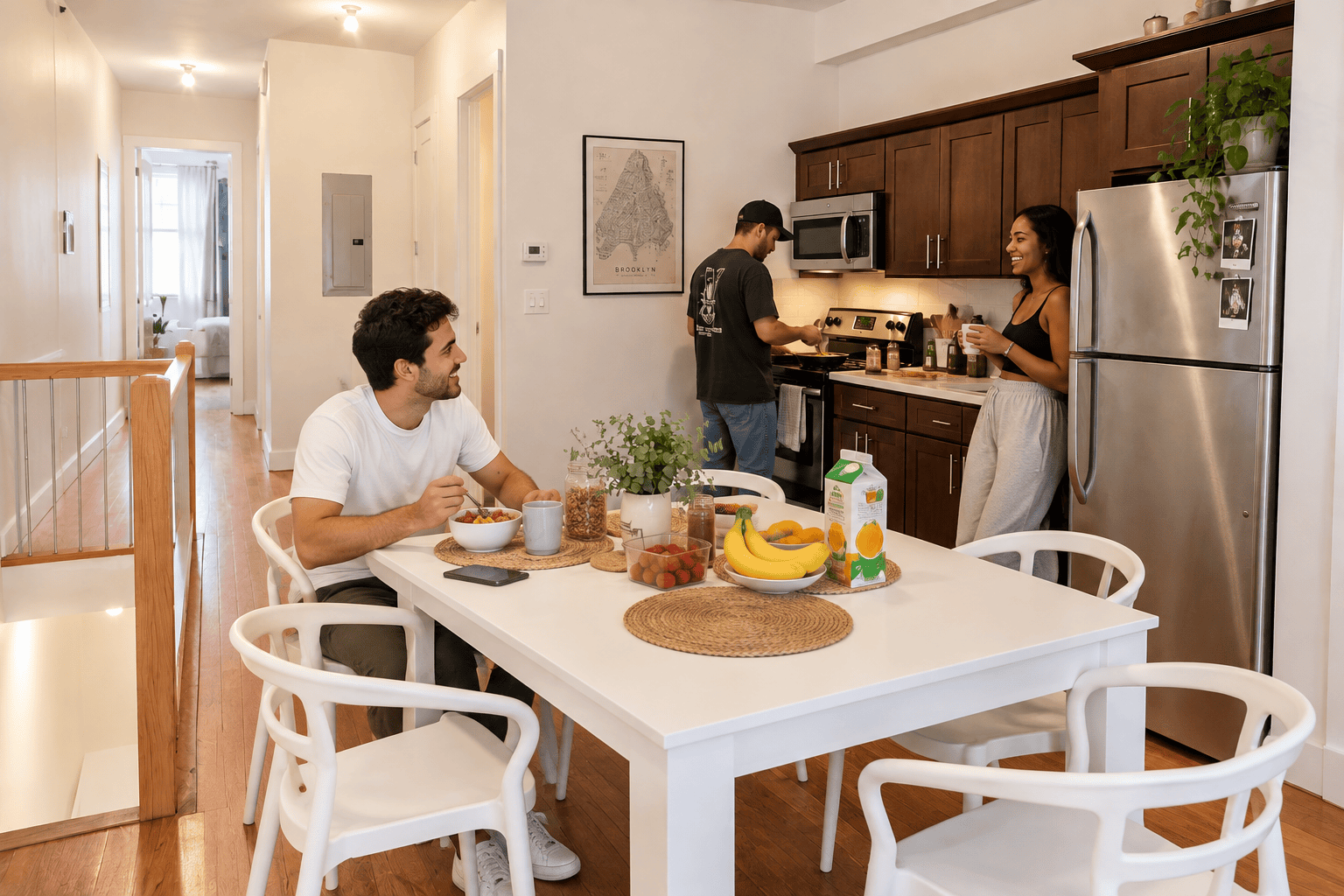
SharedEasy has coliving homes on the Upper West Side (Central Park West and Columbus Homes) and in South Harlem. Coliving means you rent a furnished private or shared room in a home with shared kitchen and living areas, with housemates your age. Rooms in NYC start from $840 a month, all-in, and private rooms in Manhattan fall in the $1,400-$2,369 range. That price includes utilities, WiFi and weekly cleaning of common areas.
- No broker fee, no application fee.
- No U.S. guarantor or U.S. credit history required.
- Deposit-Free Living on contracts shorter than six months, so you don’t tie up a month’s rent in a deposit.
- Stays from 30 days, month-to-month, with your room ready within 24 hours of your agreed check-in date.