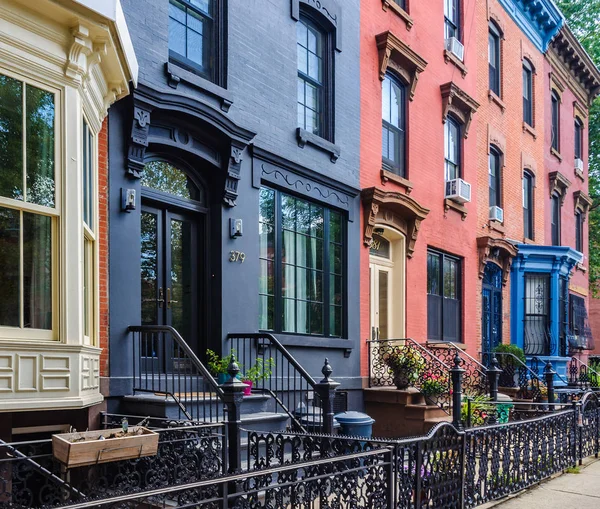
Income restricted apartments are rental units where both who can live there and how much the rent can be are capped by household income. To qualify, your household has to earn at or below a set share of the Area Median Income (AMI), for example 60% or 80% of AMI, and the rent is fixed at a level people in that income band can pay, usually around 30% of their income.
So when a listing on Zillow or StreetEasy says “income restricted,” it means the unit is not open to everyone at market price. You apply, you prove your income and household size, and only households inside the posted income range can sign the lease.
This guide explains how AMI and income limits work (with New York City’s 2026 numbers), what “80% income restricted” actually means, how the rent is set, how these units differ from Section 8, rent-stabilized and public housing, and how to apply in NYC. It is written for renters, especially students and interns and anyone new to the city.
What does income restricted mean?
“Income restricted” describes a rule attached to the apartment, not to you. A building gets public money, a tax credit or a zoning bonus, and in exchange the owner agrees to rent some or all units only to households under a certain income, at a capped rent, for a set number of years.
Three things follow from that deal:
- There is an income ceiling. Earn more than the limit for your household size and you cannot rent the unit.
- There is usually an income floor too. Each listing shows a minimum income, because the household still has to be able to pay the capped rent.
- The rent is capped. It is set by formula from the income band, not by what the market would pay.
You will also see the phrases “rent restricted,” “income based” and “below market rate (BMR).” They overlap. Rent restricted means the rent is capped; income restricted means eligibility is capped; most program units have both. “Income based” often refers to programs where your own rent moves with your income, such as public housing.
How AMI and income limits work
Area Median Income is the midpoint household income for a metro area: half of households earn more, half earn less. HUD defines it every year for every area in the country, with separate figures by household size. Income limits are then written as a percentage of that number.
New York City AMI in 2026
According to NYC Housing Preservation and Development (HPD), 100% of AMI in New York City in 2026 is:
For a single person, that works out to these income caps:
Two things surprise people here. First, NYC’s AMI is high, so “income restricted” does not only mean very low income: a single person earning $90,000 can qualify for an 80% AMI unit. Second, the limits rise with household size, so a couple gets a higher cap than a single renter for the same band.
What “80% income restricted” means
“80% income restricted” means the unit is reserved for households earning no more than 80% of AMI. In NYC in 2026, that is up to $95,040 for one person. The same logic reads for any number: a 60% unit caps a single renter at $71,280, and “140% income restricted” is a middle-income unit where a single person could earn up to about $166,320 (140% of $118,800). The listing still sets its own minimum, so check both ends of the range.
How the rent is set
HPD treats housing as within reach when it costs about one-third or less of what the household earns. Program rents are built on that rule: take the income for the band, take roughly 30% of it, divide by 12, and adjust for the unit size.
An example with the 2026 numbers: 30% of the 80% AMI cap for one person ($95,040) is $28,512 a year, or about $2,376 a month. Actual listed rents are set per unit size from HPD’s rent tables. In HPD’s 2025 table, the maximum rent for a studio was $1,417 at 50% AMI, $2,268 at 80% AMI and $2,835 at 100% AMI.
The key point: in a lottery unit the rent is fixed for the unit’s band. It does not go down if you earn less than the cap. That is different from public housing and Section 8, where your share of the rent is tied to your own income. If you want a sense of how rent fits a budget in general, see our NYC rent budget guide.
Income restricted vs Section 8 vs rent-stabilized vs public housing
These four get mixed up constantly. Here is how they differ for a renter in NYC:
A few details matter in practice. A Section 8 voucher is attached to you and used in a private apartment you choose, while an income restricted unit is attached to the building. Rent-stabilized apartments have no income requirement at all; you get the right to renew your lease and increases set each year by the Rent Guidelines Board (more in our rent-stabilized apartments guide).
How to apply for income restricted apartments in NYC
In New York City, most new income restricted rentals financed by HPD and the Housing Development Corporation (HDC) go through NYC Housing Connect, the city’s official lottery site. Here is how it works:
- Create a profile on Housing Connect. Enter everyone who will live with you and your total combined household income. Eligibility for each lottery is based on those two things.
- Apply to open lotteries that fit. Filter by borough, income and household size. Each listing shows the AMI bands, unit sizes, rents and the income range per household size.
- Wait for your log number. A few weeks after the deadline, Housing Connect randomly assigns log numbers to every complete application. Some lotteries give priority to people with disabilities, seniors or residents of the same neighborhood.
- Get invited to an interview. If your number comes up and you appear to qualify, you are invited to an eligibility interview, usually 2 to 10 months after the deadline.
- Bring your documents. Expect to show pay stubs, W-2s or benefit statements, bank statements for assets, rent history or a credit check, and IDs for everyone in the household.
Housing Connect also lists re-rentals: units in existing income restricted buildings that open up and are offered first come, first served, with no lottery. You can apply regardless of citizenship or immigration status.
Never pay to apply. NYC 311 states that you do not need to pay any broker fees or application fees for HPD and HDC projects listed on Housing Connect. Anyone asking for money to “guarantee” a lottery unit is running a scam; report it to 311. For the paperwork itself, our rental documents checklist covers most of what an interview asks for.
Pros and trade-offs
The upside is real. Your rent is capped by formula instead of following the market, and it is set before you apply, so you know the number up front. For renters priced out of market-rate studios, that fixed number is the whole point.
The trade-offs are just as real:
- Odds and waiting. Lotteries are random, and interviews can come months after you apply. Plan on applying to many lotteries, not one.
- Income has to fit a range. Earn too little for the minimum or too much for the maximum and you are out, even if the gap is small. A raise before your interview can push you over.
- Paperwork and re-checks. You document income and assets up front, and some programs re-check it. Public housing, for example, must re-check household income at least once every 12 months; ask what applies to your building.
- Less flexibility. You take the unit, borough and move-in date that come up, on a standard lease. That rarely matches a semester, an internship or a first job start date.
If you need a room while you wait
SharedEasy does not offer income restricted units, and a room is not a substitute for a lottery win. But if you need somewhere to live in NYC now, while your applications are pending, SharedEasy rents rooms in shared homes in Brooklyn, Manhattan and Queens from $840 a month, all-in: utilities, WiFi and weekly cleaning of common areas included. Leases run month-to-month from 30 days, with no broker fee, no application fee and no U.S. guarantor required, so you can leave when your lottery apartment comes through.